
Planning a trip to Vietnam
Plan your Vietnam trip with advice on when to go, places to visit and a 19-day itinerary that also takes in Cambodia's Angkor temples.

What do you need to know before travelling to Vietnam? What are the best months to visit it? Where to go? and what are the places that you shouldn’t miss? What route can you take? Here are the answers to these questions. Also, there is a lot of information to prepare your trip on your own!
Before going
Before travelling to Vietnam, you should check if you need vaccination, visa, in which zones you need to be careful, important phone numbers, etc. Your country may have an official website with that information (usually the website of your country’s embassy in Vietnam). If you're a citizen of Spain or one of 12 other eligible countries, you can enter Vietnam without a visa for up to 45 days, a measure running until 14 March 2028. For other nationalities or longer stays, you can apply online for an e-visa valid for up to 90 days at evisa.gov.vn.
Check this website Vietnam: Weather & when to go – SelectiveAsia to know what are the best months to visit Vietnam. There is useful information like when are the local celebrations. You can also see the weather per month through simple maps.
About the transport between cities, there are several options: airplane, train, bus, private car, motorbike and bike. All the information that you need to get around Vietnam is in this dedicated post: Vietnam Transportation Guide.
If you plan to go on your own by public bus, or to take a route by bike/motorbike, or you want to know where are the touristic places, then you can download an offline maps’ mobile application. Good options are Organic Maps or OsmAnd. They are very useful since they provide offline GPS location, and you can import your own maps/routes.
The language. In the touristic places there’s no problem communicating because they usually speak a little English (hotels, restaurants, agencies). In other environments it is complicated. It might be helpful to know a few words or to bring notes in Vietnamese (like addresses).
And what kind of food you’ll find in Vietnam? Its food has been influenced by other countries like China, France, India and Japan, so there is a wide variety. The most typical dishes are pho (noodles soup), banh mi (sandwich), bun cha (stuffed meat rolls), fish, vegetables, rice, etc. On Vietnamese Cuisine – Wikipedia there is a list of dishes and more information.
Going over the history of Vietnam is an important task that you should do. One thousand years of struggle for independence has left a mark on them and on their culture, food, religion, architecture, etc. So it is essential to know in advance a little bit about what happened there to make the most of your trip. This way, you’ll not only better understand their way of being and culture, but you’ll feel admiration for the Vietnamese people.
Something important to know to avoid cheats: there are hotels with the same or almost same name, and also on the same street. The taxi drivers may try to trick you, stopping at a different hotel. Besides, some taxis have tampered the taximeter. You can read more on Reliable Taxi Companies.
Things to do in Vietnam
Going to this country implies being filled with unforgettable experiences. Some activities that you should do are: Visiting temples and the imperial tombs, knowing the country’s history, trying its cuisine, doing sport in a nature park, meeting ethnic minorities, and relaxing on the beach. In this section, I will indicate you which places you can visit and what activities you can do, as well as important links to check the information that you need.
| 🔗 Vietnam Travel Official Web – Some information about the destinations, places included in Unesco World Heritage, search by map what to visit or do in each region… |
In your itinerary you should include Hanoi, the country’s capital. There you can lose yourself in the chaotic old quarter while you dodge the motorbikes and discover street markets, temples and many craft shops. It’s essential to go to the Hoan Kiem Lake, visit the Vietnam Museum of Ethnology and the Temple of Literature, and also to watch a water puppet show.
| 🔗 Thang Long Water Puppet Theatre – Theatre where you can see a show of water puppets. 🔗 Vietnam Museum of Ethnology – Official Web 🔗 Temple of Literature – Official Web 🔗 Hoa Lo Prison – Official Web 🔗 Lotte Center Hanoi – From the rooftop of this building you can see all Hanoi. 🔗 Things to do in Hanoi – TripAdvisor |
If you manage to survive Hanoi, another indispensable city is Ho Chi Minh (Saigon). A big city where it is impossible or very complicated to cross the street! Attractive avenues and French colonial buildings highlight between temples and alleys. You shouldn’t miss the Notre Dame Cathedral, the War Remnants Museum, The Independence Palace and the Post Office. A little bit further you can find the Jade Emperor Pagoda and the Sacré Coeur.
| 🔗 War Remnants Museum – Official Web (the English version doesn’t work correctly, it’s better to translate with the browser tool for more up-to-date prices and timetables…) 🔗 The Independence Palace – Official Web 🔗 Things to do in Ho Chi Minh (Saigon) – TripAdvisor |
A fundamental event which marked the Vietnamese people was the Vietnam War. If you want to know more about it, you can visit several museums in the country and also explore two important locations: the Cu Chi Tunnels, close to Ho Chi Minh, and the Demilitarized Zone (DMZ) situated to the north of Hue (beyond Dong Ha).
| 🔗 Historic Relic & CuChi Tunnel Complex – Official Web 🔗 Cu Chi Tunnels, Vietnamitas en Madrid – Blog with more information 🔗 Vinh Moc Tunnels and the remains of the DMZ, Vietnamitas en Madrid – Blog with more information 🔗 Vietnam War Sites – Wikipedia |
The most important Imperial Tombs are located in Hue, another city to add to your adventure. Besides, you can visit The Citadel and several pagodas. Near Hue there is a very popular and scenic town called Hoi An. This town preserves more than 800 historical buildings and it was an important commercial port. Another reason to add Hoi An to the route are the ruins of My Son, it’s possible to visit them in a day trip or even in half a day. If you have never been in temples like Angkor in Cambodia or Ayutthaya and Sukhothai in Thailand, visiting My Son can be a good idea but you’ll may be disappointed if you have seen already the others temples (reviews on TripAdvisor).
| 🔗 Imperial Tombs, Route by Motorbike along the Mausoleums – Special post with more information 😊 Thing to do in Hue – TripAdvisor 😊 Hoi An World Heritage – Official Web 😊 Tourism in Hoi An – Local web with more information 🔗 My Son, The World Cultural Heritage – Official Web (there’re some problems with the English version, it’s better to translate it with the browser tools) 🔗 Thing to do in Hoi An – TripAdvisor |
If you want to relax on a beach these are the popular places: Phu Quoc Island, Con Dao Island, Mui Ne, Nha Trang and An Bang (the last is near Hoi An). Another well-known place to enjoy the sea and the natural environment is the Halong Bay. I’m sure you have heard about the bay, its karstic elements are very famous and photographed. However, if you don’t like crowds, I suggest you the Lan Ha Bay, near Ha Long and easily accessible from Cat Ba Island. There are fewer tourists and it is beautiful as well.
It is possible to combine the relax on the beach with some sport. You can do several activities like kitesurfing, kayaking, paddle surfing or diving. On TripAdvisor, you can search things to do in each place, beaches and the important points. There is a map with the locations below.
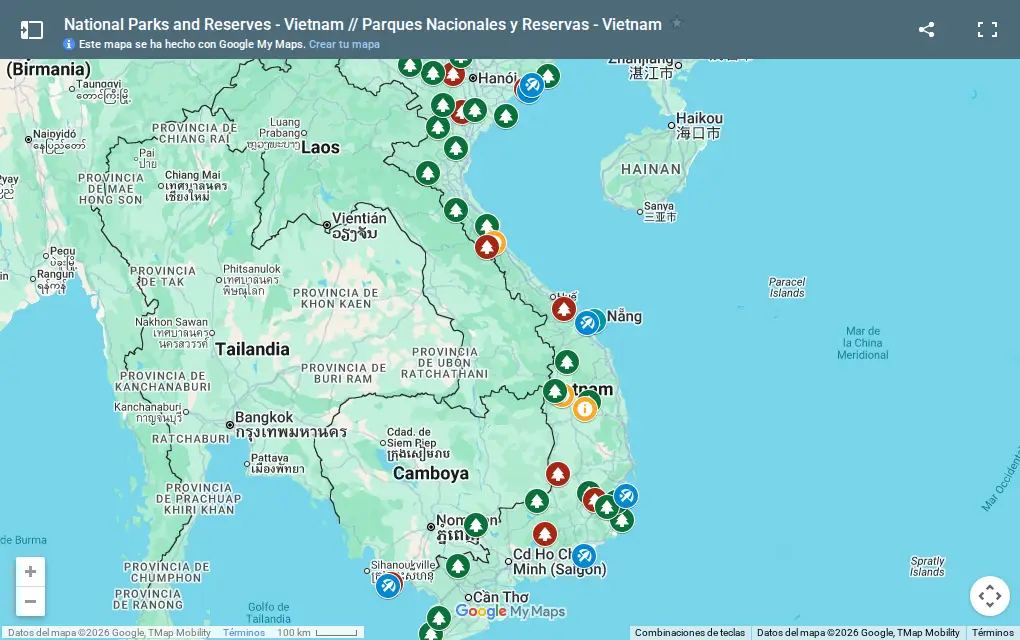
Continuing with the relaxing part: another activity that you should do is to explore a national park or reserve through a hiking route or by canoe, I’m sure that will bring you energy and peace. But which park to choose? There are many of them in the country, some more popular than others. In the next map you can check their locations and, if you click on the icons, you will see the website (if there is any). The red icons are the most famous parks. Another place where the most of the travellers go to do trekking is the north of Vietnam. There you’ll discover the best landscape in the country and also you mingle with the minority people in their towns and markets.
I still recommend the north. Ha Giang became part of Tuyen Quang province in July 2025, although everyone still calls it Ha Giang. Foreigners need a border area permit for Quan Ba, Yen Minh, Dong Van and Meo Vac, costing about 250,000 VND through Ha Giang city's immigration office or an agency. Since June 2026, police checkpoints ask for it. Vietnam doesn't recognise international driving permits issued in Spain and many other countries, so if that's the permit you hold, you cannot legally ride a motorbike there.
| 🔗 The best of Northern Vietnam is not Sapa, Dong Van and its incredible Karst Plateau Geopark – Special post with more information 🔗 List of national parks of Vietnam – Wikipedia – List of national park where you can check more information |
You can view the larger map if you click on the upper right corner.
A popular place outside Vietnam which is visited by many travellers is Temples of Angkor in Siem Reap (Cambodia). It’s typical to add this incredible and beautiful place if you visit Thailand or Vietnam because the flight lasts only one hour or so. Two or three days is enough to enjoy the best parts of the country. Obviously, Cambodia has many other nice places besides Angkor but, if you don’t have time or money, a three-day getaway is a good option. On the post, Short Trip to Siem Reap you can find tips and all you need to prepare the short trip.
Since October 2023, you'll land at the new Siem Reap-Angkor International Airport (SAI), about 45 km from town. The old airport has closed, so allow about an hour for the transfer: around 8 USD by shuttle bus or 30 USD by taxi. In 2026, the Angkor Pass costs 37 USD for 1 day, 62 USD for 3 days or 72 USD for 7 days. Beng Mealea is included.
Responsible Tourism. It’s very important to keep in mind that there are some tours and activities that you shouldn’t carry out. To keep you informed you can read some web pages about responsible tourism:
| 🔗 Education for Nature – Vietnam 🔗 Responsible Tourism – Change for Animals Foundation |
Apart from all this advice, there are some other activities you can do: street food tour, bike route, enjoy some celebrations of the country, explore caves, motorbike tour, climbing in Cat Ba.
Finally, I recommend you to read these Tips to plan your trip to Vietnam with information about renting a motorbike, public buses, delays and cancellation of flights, the ATMs fees…
My Route – 19 Days in Vietnam and Cambodia
From April 6th to 25th 2017, if I don’t count the flights we had 18’5 useful days. The sunrise and the sunset were around 6 am/pm. We visited these places:
- Ho Chi Minh (Saigon).
- Siem Reap in Cambodia.
- Short stop in Danang.
- Hue. More information on Imperial Tombs.
- Hoi An (Hai Van Pass – French Fort – Marble Mountains)
- Dong Van, in the Ha Giang province. My experience and information on The Best of the northern Vietnam is not Sapa.
- Hanoi.
- Cat Ba.
If you aren’t still clear about your itinerary you can see mine with more details ideas on the post: Itinerary 19 days in Vietnam and Cambodia. Also, you can check the travelers’ top-rated places in Vietnam on TripAdvisor.
My itinerary on Google Maps (accommodation, restaurants, cities, transports between cities):
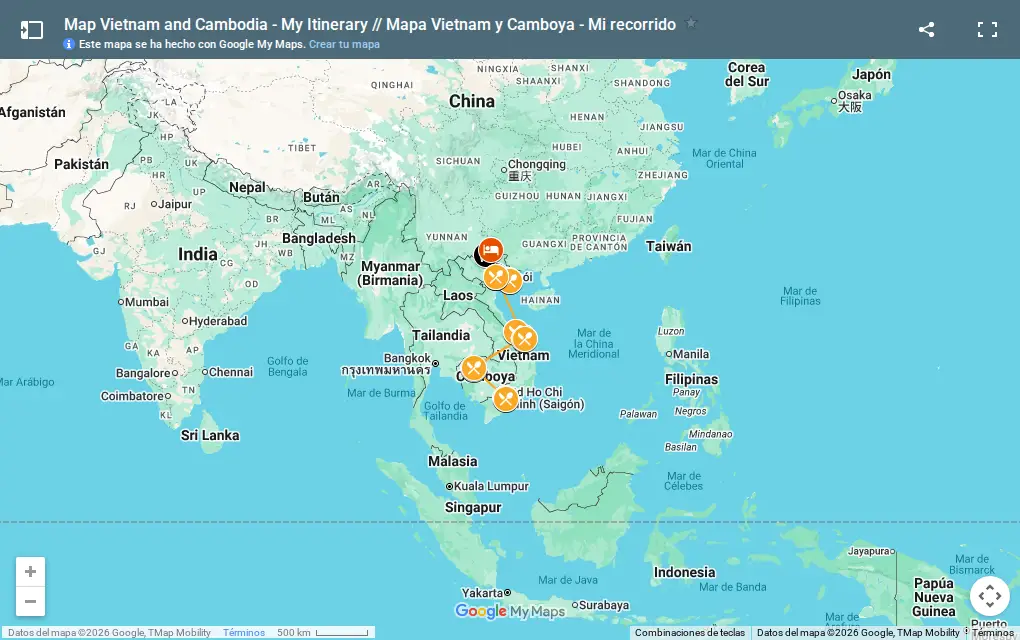
These were the places which I chose for my adventure of almost 3 weeks. You can see more details of my route on the next posts I will publish soon. There’re many cities and nice places that I couldn’t visit like Dong Hoi and its famous caves of the National Park of Phong Nha-Ke Bang, Phu Quoc Island, Con Dao Island, Ninh Binh and many others… but I’d have needed a month to go to all of them!
Do you know any website which has helped you to prepare your trip? You can share here and I will add it to the list!
Comments (0)
No comments yet.
Leave a comment